The importance of the relationship between product and marketing is something that’s often overlooked.
But when the product and marketing teams aren’t on the same page regarding the product and the problems it aims to solve, chances are the marketing won’t match the product’s value proposition and in turn, will discourage potential users from signing up.
This could be detrimental to the success of a product organization.
So, what can you do to avoid these miscommunications and build a synergistic relationship between the two?
In this article, I’ll share some tips and information that will be critical in strengthening the relationship and performance of the product and marketing teams at your company to achieve success.
This is a guest post by Nandini Sharma, an Assistant Marketing Manager at ProofHub – a leading collaboration software. With years of experience in marketing, she has found some amazing ways to reach a large audience and create a connection.
The term team management isn’t just about allocating tasks to be checked off by your team before the end of the day. Key factors that contribute to the concept of effective team management are teamwork, collaboration, and recognition. Without them, a company’s overall performance is at risk. This is where team management tools come into play.
Unfortunately, no matter how hard a project manager tries or how many expensive tools she/he invests in, something or someone is often left behind. And here in-lies our problem…
…and where there is a business-related problem, there is a Process Street solution.
You see, not all team management tools are meant for you. Without the right approach and the right tool, your chances of keeping each team member productive and satisfied, are next to impossible.
You need to find a tool that works best for you and your team and you need to find it soon.
In this article, we will explain the importance of effective team management. We will then present you with our 14 top team management tools so that you can find the right one for you.
Click on the relevant subheader below to jump to that section. Alternatively, scroll down to find the information you need to evaluate the best team management tool for you.
Team management: What it is and why it is important?
Team management is the coordination of a group of individuals to perform a specific task. Team management is a subset of the broader discipline: project management.
Project management versus team management
Project management explains how the resources of a project are organized and implemented for successful project completion.
With successful project management comes the delivery of expectations: what can be delivered, when this can be delivered, and the cost of delivery. Resources are maximized, the project cost is controlled, change is managed, and teamwork and collaboration are enforced.
Drawing on the latter point – teamwork and collaboration are enforced – it is clear that team management is a management skill vital for project success.
Team management: An essential management skill
Management skills are certain attributes or abilities a manager should possess to be effectual in their duties and to deliver the needed project results.
A team that goes through the motions, will not care for the success of your project or even your company. Effective team management is essential in maintaining a positive company culture, an environment that promotes project completion and to retain employee engagement.
With this in mind, it can be difficult to select the right tool for you. However, with our list of 14 top team management tools, choosing just got a lot easier.
Team management tools: Our top 14 picks
In this article, we present our top 14 team management software picks. We summarize the pros and cons of each tool so that choosing the right tool is easier for you.
Best team management tool for process management: Process Street
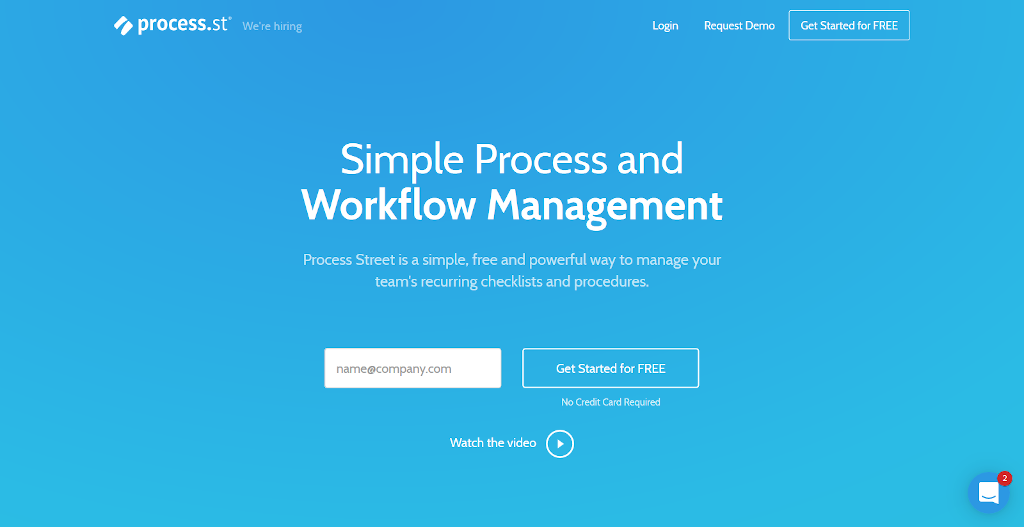
With Process Street, you can create recurring checklists, collaborate around them, track their progress, and complete projects as planned.
What the users like:
With Process Street, process and team management become a breeze. Simply:
Document every step of your project.
Transfer your documented process into a Process Street template.
Add features such as task due dates, stop tasks and role assignments to adapt and refine the management of your project and team.
Activate the template once the project commences. Once activated the template is termed as a checklist. You can have more than one checklist running from the same template at a time.
Track the progress of your team members in terms of their assigned tasks.
Receive regular email updates for each project, keeping you in the loop.
Collaborate with project members in one space.
At Process Street, we have a wealth of free template resources stored in our template library.
Approvals, to sign tasks off within your team. Tasks can be assessed by the relevant team member/s. The assigned approver can easily open the checklist. Information from the tasks is then used to either approve or reject, or reject with a comment.
It is with these features that Process Street checklists are deemed to be superpowered, and can superpower the management of your team.
What the users dislike:
Process Street is a great tool, but there’s no mobile app yet.
Pricing:
Process Street Business – $12 .50 per user per month
Process Street Business Pro – $25 per user per month
Best team management tool for scalable remote collaboration: Proofhub
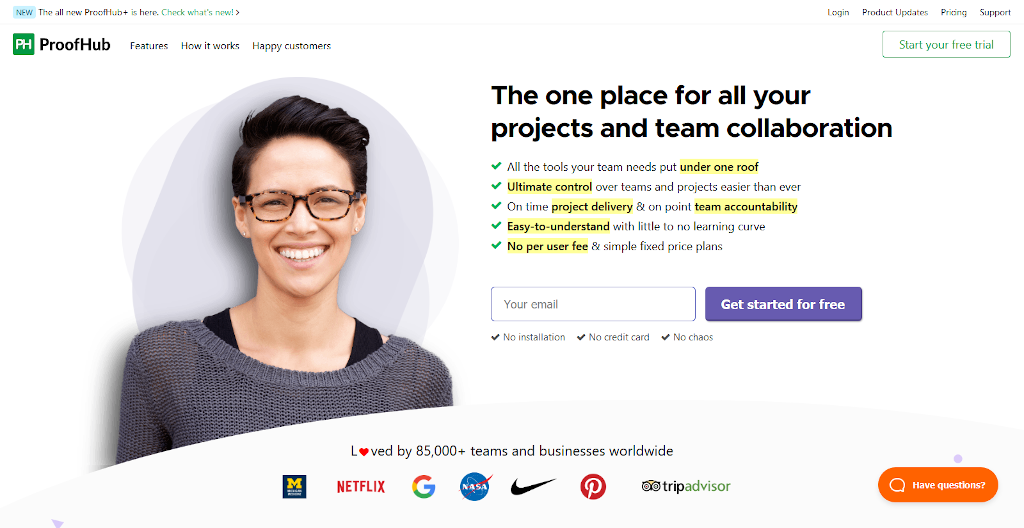
ProofHub is an online project management and team management software that helps businesses organize projects, people and get work done. The software delivers basic and advanced features for refined project or team management under one roof. This includes:
What the users like:
ProofHub is an all-in-one solution. That is, every tool you need to manage a team, deliver a project or run a business is available in one place. Unlike other tools, ProofHub pricing doesn’t support any per-user or per-project terms and conditions.
What the users dislike:
ProofHub offers easy access to:
Best comprehensive all-in-one team management tool: Scoro
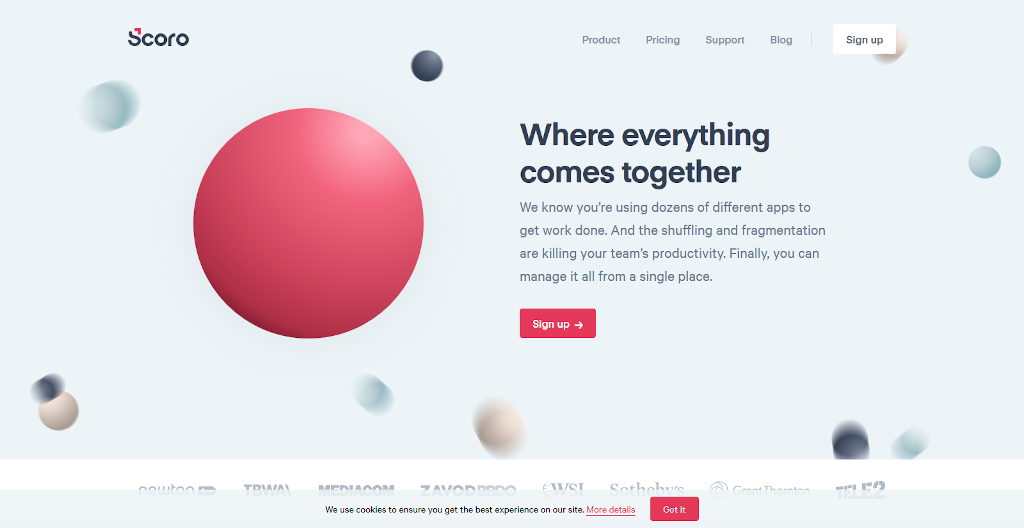
Scoro is an end-to-end project and business management solution which lets you control your entire business from one place. Scoro offers almost every feature that you need to fully manage your teams and workflows – including:
Task scheduling
Task tracking
Collaboration
CRM
Advanced reporting
Real-time dashboards
…and more.
What the users like:
Scoro is one of the most agile and flexible tools in the market, and it saves teams a lot of time whilst communicating on tasks.
What the users dislike:
Scoro doesn’t stick with all team types. For example, it doesn’t offer any on-premise solution for enterprises.
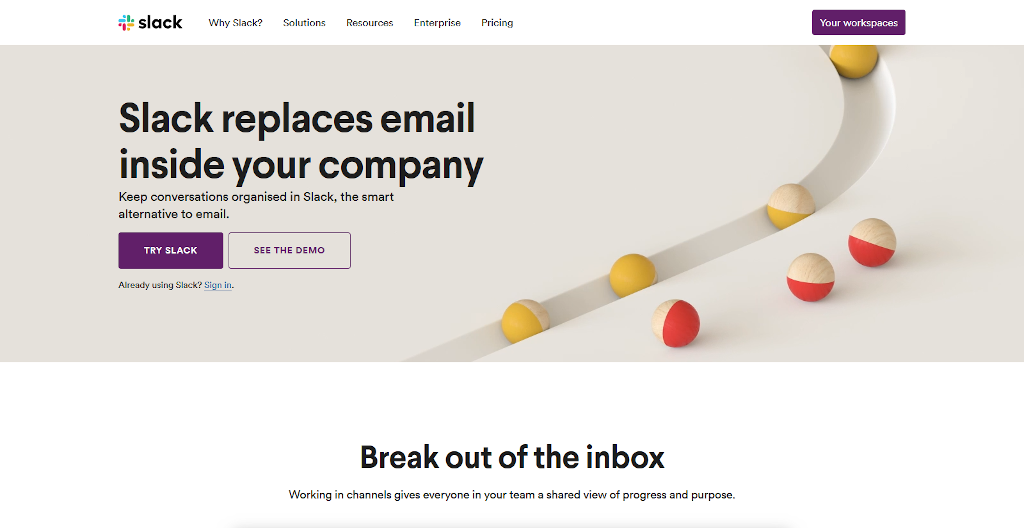
Best team management tool for remote communications: Slack
Slack is a cloud-based collaboration tool specifically designed to improve communication across organizations. Slack is a platform for teams to converse and share files (PDFs, images, documents, and spreadsheets) with easy drag and drop.
What the users like:
In addition to chat, Slack provides shortcuts and hacks for effective team collaboration to support enhanced productivity levels.
What the users dislike:
Slack offers limited integrations in the free version, and it lacks video/audio chat options.
Pricing:
Slack Standard – $6.67 per user per month (billed annually) or $8 per user per month (billed monthly)
Slack Plus – $12.50 per user per month (billed annually)
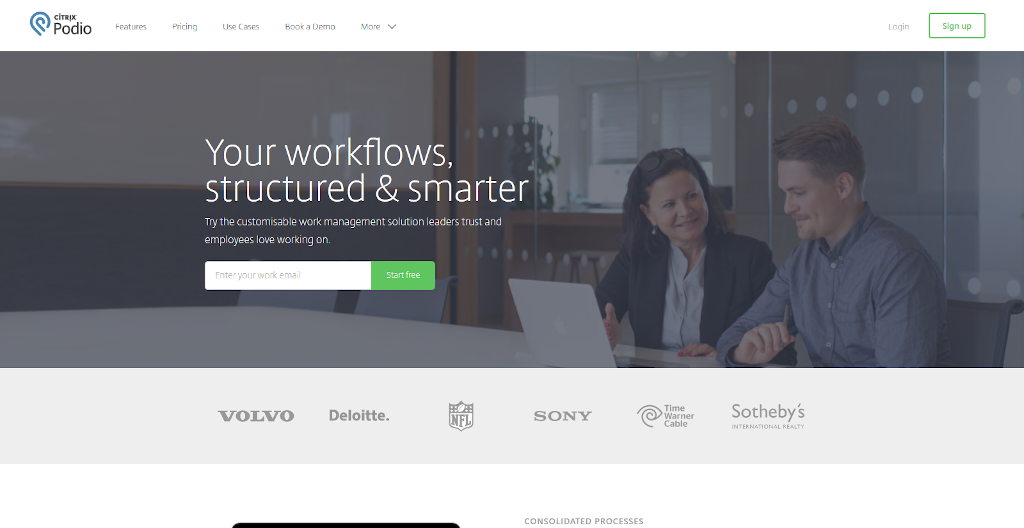
Podio is a team collaboration software that helps keep processes organized and facilitates effective communication. The core purpose of this software is to ease team collaboration and reduce team confusion, improving clarity.
What the users like:
Podio is flexible, customizable, and user-friendly – perfect for growing businesses.
What the users dislike:
Many users have said that Podio is extremely difficult to set up and that they require additional help to do it.
Pricing:
Podio Basic – $9 per month or $ 7.20 per month (billed annually)
Podio Plus – $14 per month or $11.20 per month (billed annually)
Podio Premium – $24 per month or $19.20 per month (billed annually)
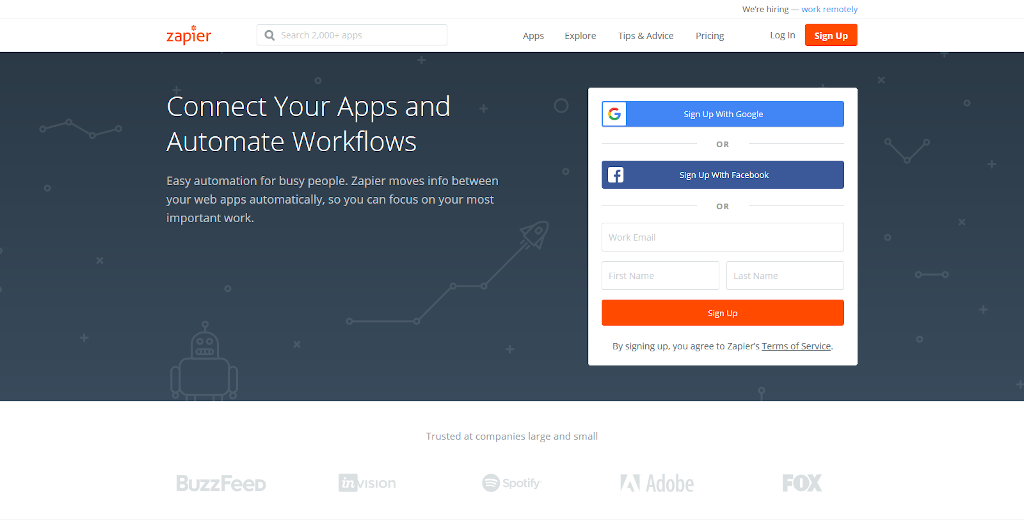
Zapier is a web-based service that connects various apps to automate workflows and elevate productivity levels. This powerful technology is designed to automate your business tasks better and help your teams accomplish more with 10x the impact.
What the users like:
Zapier connects all the different apps a team uses. It makes tasks easier for everyone in the team and frees up their time to do other important jobs.
What the users dislike:
Zapier gets expensive when you use too many of its zaps.
Best team management tool for productivity: Clickup
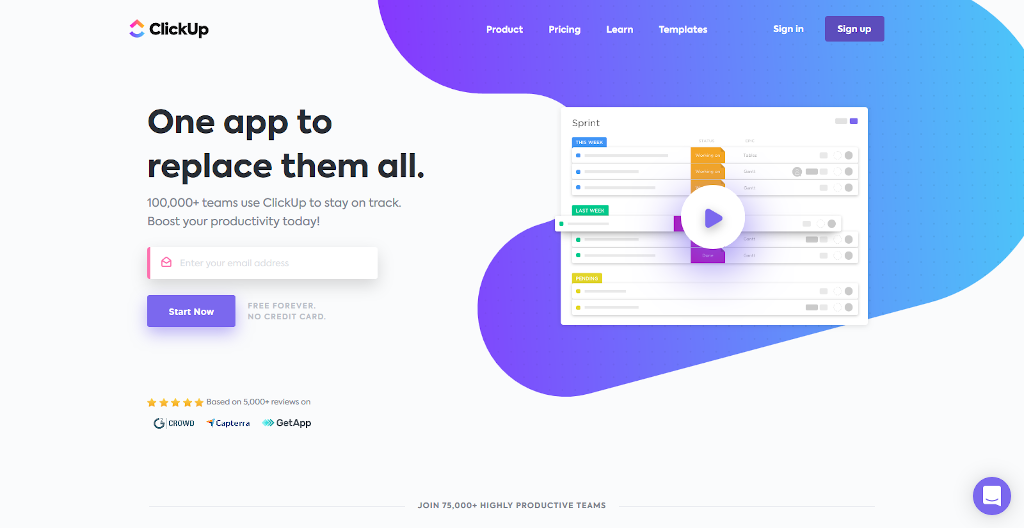
ClickUp is an online work management solution or productivity software. It helps individuals and teams tune tasks and manages workflows in a more collaborative, efficient manner. It’s one tool for all, from task management, collaboration, reporting/project tracking, time tracking to Gantt charts – ClickUp offers all the features you need in one place.
What the users like:
ClickUp offers great discounts on annual subscriptions – you can save 45%. Compare this to tools where savings are limited to 15% – 20%.
What the users dislike:
ClickUp limits storage in a free plan (100 MB) and it does not include integrations with Google Drive and DropBox.
Pricing:
ClickUp Free – $0 per user per month for 1 project
ClickUp Business – $9 per user per month or $5 per user per month (annual billing)
Best team management tool for agile project management: Airtable
Airtable is a collaborative work management solution. The solution allows organizations to manage and organize everything, including projects, tasks, teams, and team communication. The key features of Airtable include:
Calendar
Kanban board
Task management
Collaboration
Reporting
Project tracking
What the users like:
Airtable has pre-built templates for multiple use cases. For instance: content development, HR, digital marketing, and more.
What the users dislike:
The task management and project management features are limited. For example, Airtable has no time tracking option for projects/tasks.
Pricing:
Airtable Plus – $10 per user per month (billed annually)
Airtable Pro – $20 per user per month (billed annually)
Best team management tool for freelancers and SMBs: Paymo
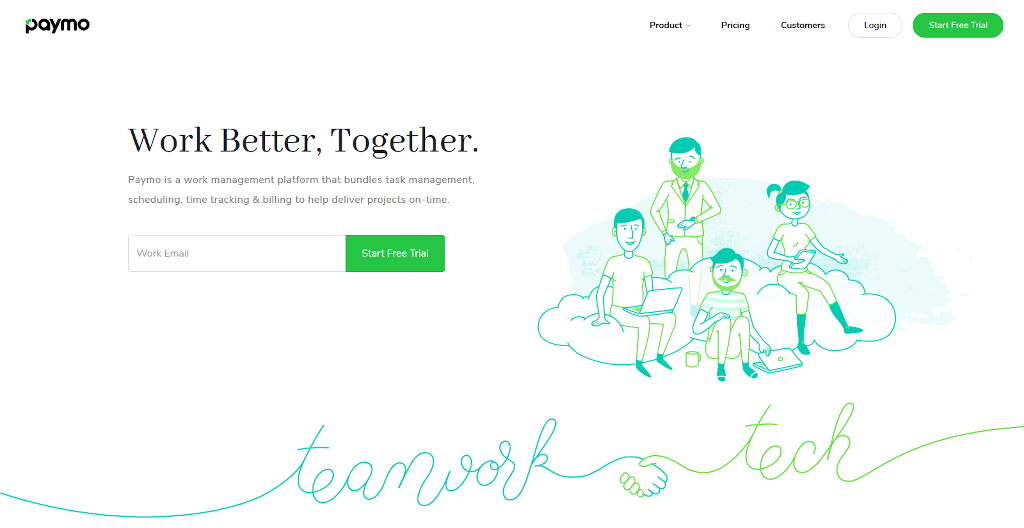
Paymo is a project and team management app for freelancers and SMBs. The app is designed to help teams with everyday work processes, such as project management, task management, resource scheduling, collaboration, time management, and project accounting.
What the users like:
Paymo has a great customer service and support team.
What the users dislike:
Users need to purchase paid plans to access basic task management functionalities like Gantt charts and resource management.
Pricing:
Small Office Plan – $11.95/user/month (or $9.56/user/month if billed annually)
Business Plan – $18.95/user/month (or $15.16/user/month if billed annually)
Best meeting software for high performing teams: Hypercontext
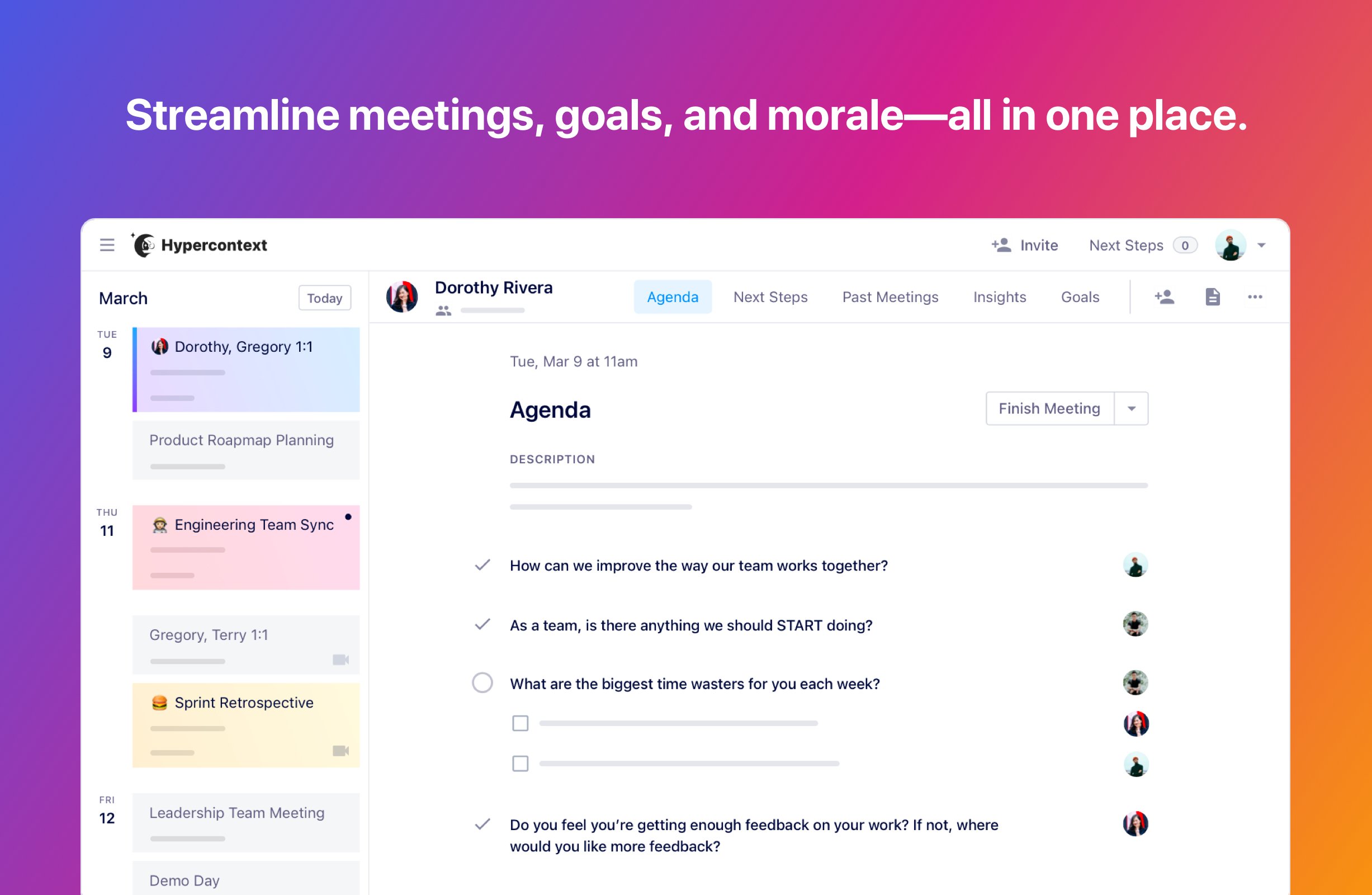
Hypercontext enables managers and their teams to be high-performing by combining quarterly priorities, recurring meetings, and engagement measures, all in one place.
With their collaborative agenda software, teams can close the feedback loop orgwide, hold one another accountable, and eliminate bad meetings. With Hypercontext, teams can:
Build collaborative meeting agendas that hold the team accountable for contributing to conversations and showing up prepared to every meeting
Automatically send meeting notes to participants
Collect real-time employee feedback to improve meeting quality and keep a pulse on employee engagement
Hold your team and self accountable for the things you agree to during meetings with their Next Steps tracker
Access a massive library of resources including 500+ conversation starters, 60+ agenda templates, and 250+ goal examples across every role in tech
…And so much more!
What the users like:
Hypercontext makes it easier for managers and employees to have productive conversations when they meet, especially in the context of 1:1 meetings. It’s also a great accountability partner for teams, ensuring that nothing falls through the cracks week-over-week. Hypercontext customers love that they can have discussions, brainstorming sessions, and prioritization exercises asynchronously.
What the users dislike:
There’s always room for improvement when it comes to some UX quirks that can occur within the app. However, the Hypercontext is the gold standard for frequently releasing feature improvements and UX/bug fixes so any quirks that surface typically go away within a week.
Pricing:
Basic – Free forever with no limits on users
Pro – $7 per user per month
Business – $11 per user per month
Hypercontext also has a small team discount for Pro accounts. Teams of up to 5 users only have to pay $5 per month total.
Best team management tool for simple asynchronous communications: Chanty
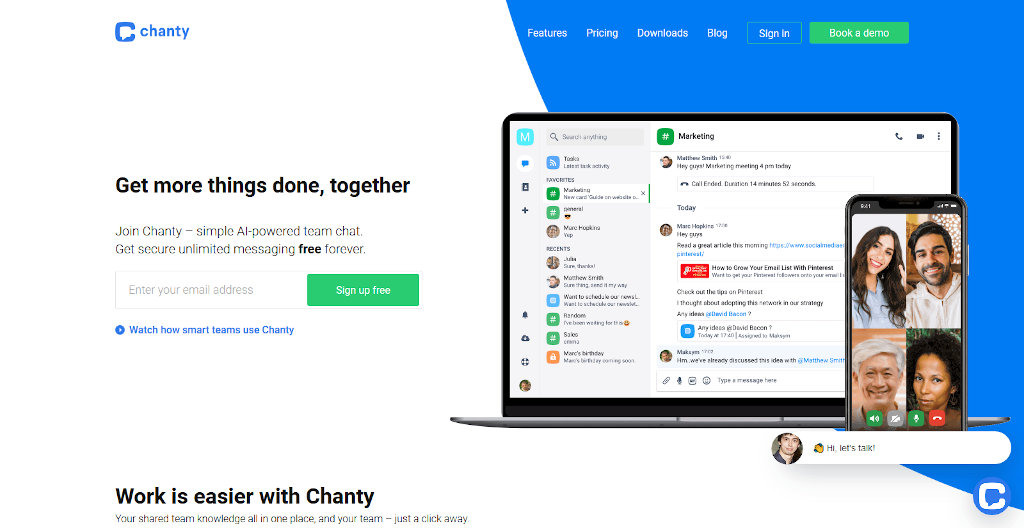
Chanty is an AI-powered team chat app designed to simplify and streamline communication between teams, irrespective of their actual geographical location. The application provides features to help teams with everyday work processes like collaboration, messaging, file sharing, workflows, and task management.
What the users like:
Overall, Chanty is one of the most intuitive and easy-to-use team chat apps. The biggest plus point of this tool is that it doesn’t burden teams with unnecessary functionalities – it simply provides features/tools that support work and workplace communication.
What the users dislike:
Chanty users often state that they wish to see more powerful third-party integrations and a few advanced communication features. But their wishes didn’t come true, yet.
Pricing:
Free plan – $0 per user per month for teams with up to 10 members
Business plan – Starts at $3 per user per month (annually billed)
Best team management tool for timekeeping & timesheets: Harvest
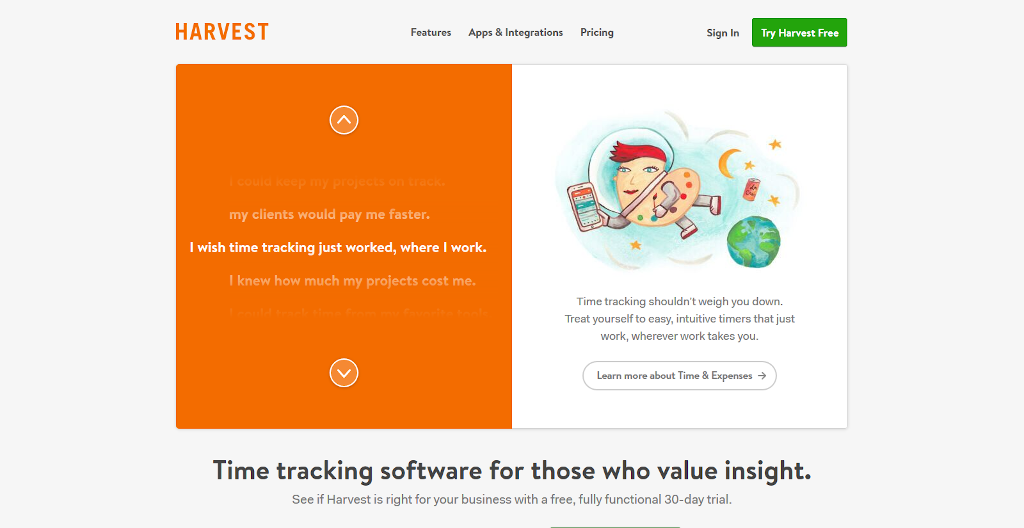
Harvest is an online business management tool. Businesses and individuals can use this tool to track time, generate professional looking invoices, communicate with clients, and update time/data on the weekly timesheet with a click of a button.
What the users like:
It’s a money-saving investment. With Harvest, teams can manage time tracking, oversee/update timesheets, create/mail invoices, access many integrations, plus more with a few clicks – and with good pricing.
What the users dislike:
Lack of permission sets often upset Harvest users. The tool can seriously do better in terms of customizable permissions.
Pricing:
Free Plan – $0 for 1 person and 2 projects
Solo Plan – $12 per month for 1 person and unlimited projects (annually billed)
Team Plan – $12 per person per month for 2+ people and unlimited projects (annually billed)
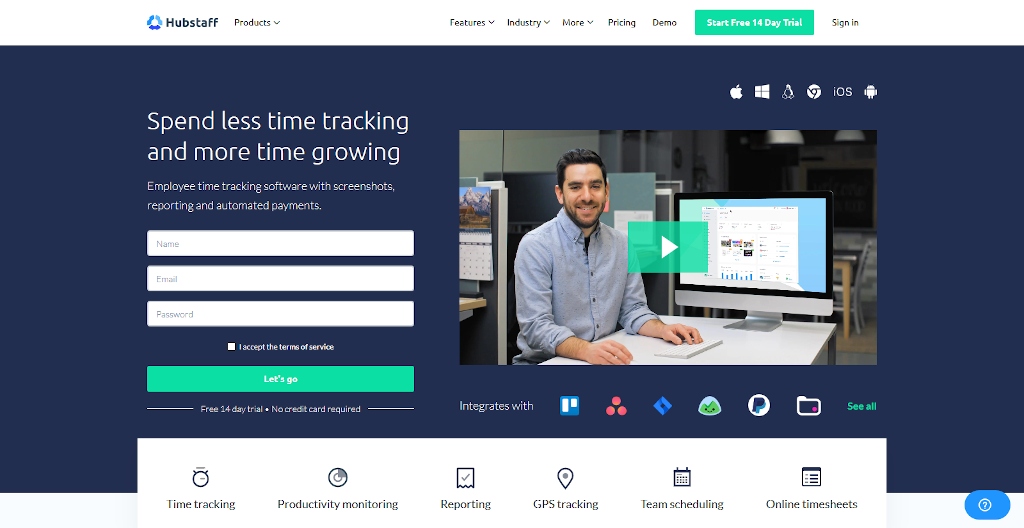
Best team management tool for staff management: Hubstaff
Hubstaff is a time tracking software, but it acts more than that. In addition to tracking time during business hours, Hubstaff allows teams to access advanced capabilities like:
Automatic payroll
Online timesheets
GPS
API
Client invoicing
Advanced reporting
Automatic payroll
…and more.
What the users like:
Hubstaff is great for remote teams. It makes time tracking, progress monitoring, and task management super easy.
What the users dislike:
Hubstaff users have stated that sometimes when they’re watching a video, reading or having a video call, the tool marks them idle. They all wish Hubstaff could measure activity even when still.
Pricing:
Free Plan – $0 for 1 user
Basic Plan – Starts at $7 per user per month
Premium Plan – Starts at $10 per user per month
Enterprise Plan – Starts at $20 per user per month
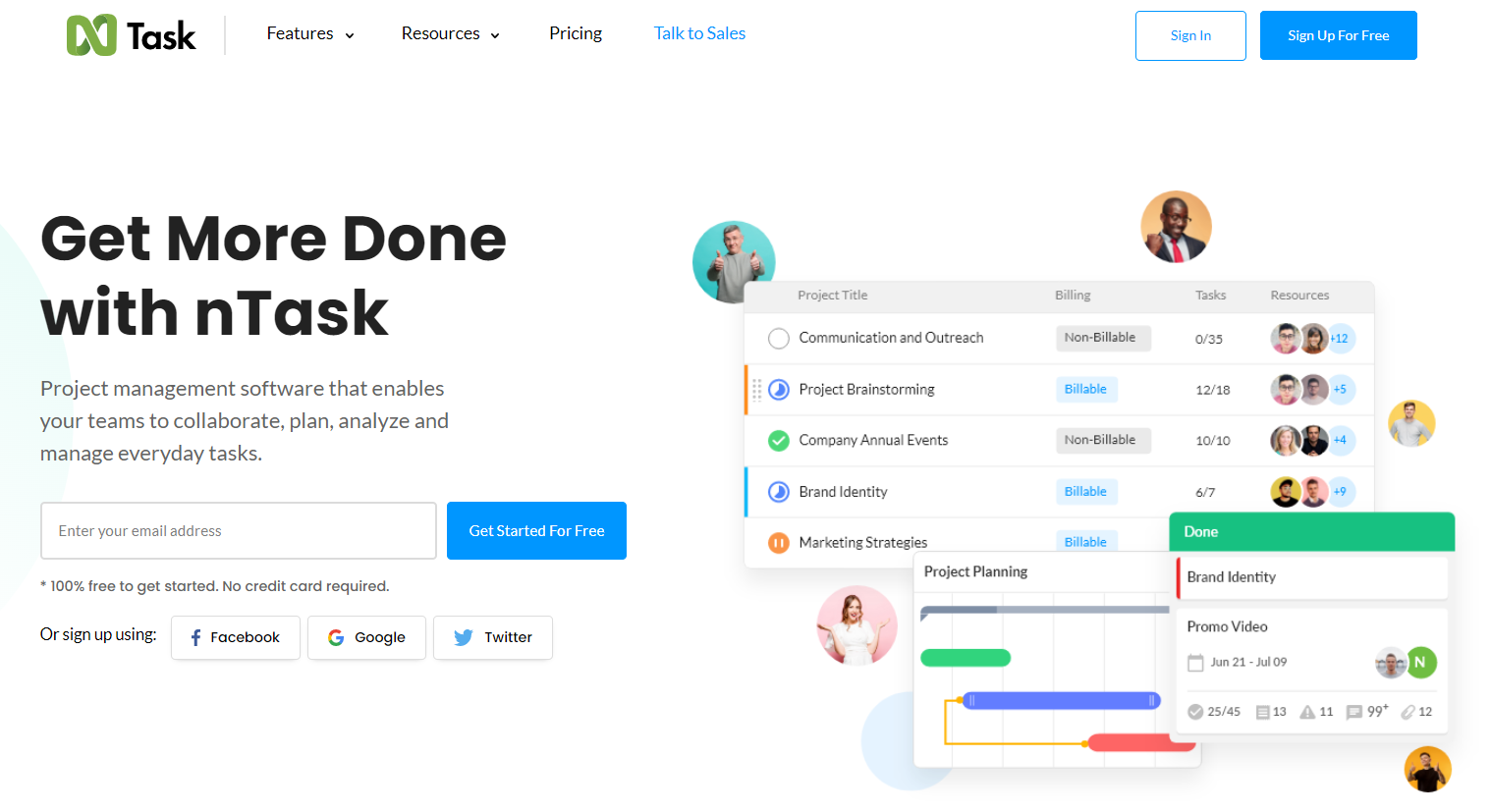
Best comprehensive all-in-one project management tool: nTask
nTask is an all-in-one project management tool that allows all of the project managers and their project development team members to track and manage the tasks and activities that they have to perform regarding the project development process.
Some of the other features that this amazing application has to offer are as follows:
Task management
Team collaboration
Risk management
Time management
Meeting management
Bug tracking
Issue management
Kanban boarding
Gantt charting
….and much more.
What the users like: nTask became an immediate favourite of its users because of its remote effectiveness. The application has incredible team collaboration and task management features that let the project managers know exactly what their team is doing, so they can call them up for immediate feedback.
What the users dislike:
Most of the users that used the software complained that there should be more templates to get them started.
Superpower your team management processes with Process Street
We have already introduced Process Street as a top business process management tool. Process Street is superpowered checklists, and it is with Process Street checklists that you can superpower your team management processes.
For those of you that are unfamiliar with Process Street and our offerings, check out our Monthly Webinar: An Introduction to Process Street below, for further insight.
Process Street can integrate with many other top project and team management applications. This is a key and rare feature.
This is done through integrations using Zapier (already mentioned above ).
You need to choose a tool that is right for you. But, as often is the case, there could be 1,2,3 or more tools working in collaboration to fit your needs. With Process Street, and our available integrations, you can link your team and project management tools together, creating an all-in-one collaborative management software. Play around with these 14 top tools we have presented to you today, and see what works for you.
Choose the right team management tool for you and your business
It’s no secret that when it comes to managing teams and ensuring teamwork, you, as a project manager, have to work twice as hard than others. You perform and oversee so many different aspects – from tracking the overall project progress to tracking each individual’s time and performance. Moreover, it is also you who has to make teams feel more comfortable and reduce work-related stress.
That means you’ll need help.
We have listed our top team management tools in detail.
Use this list so that you don’t waste time and get all the help you need to make team management trouble-free.
Are you already using team management software? Is it included in our list? If not, then tell us all about it in the comments section below. We would love to hear about your favorite team management tool/s, and how these tools make your job easier.
Knowledge is power, but you need a system in place to harness that power effectively.
Everything that happens in your business depends on some kind of specialized knowledge, whether it’s new employee onboarding, dealing with customer requests, compliance issues, or marketing a new feature launch.
Your knowledge management system is the firm foundation upon which you build your business.
Despite this, statistics show that as many as 40% of employees do not utilize proper knowledge management solutions, and between 7-20% of their time is spent figuring out a problem from scratch when the solution already exists somewhere in the company.
These bad business practices cost Fortune 500 companies $31.5 billion each year.
How much money are you losing, and how much time are you wasting without a proper knowledge management system in place?
Knowledge management shares many fundamental principles with the idea of business process management (BPM), and as such it’s possible to use BPM software like Process Street to implement a powerful knowledge management system.
Fleet management is so much more than simply owning and operating vehicles. It’s a complex interplay of many different factors and optimizations – much like the concept of business process management.
In recent years, more and more tools for fleet management optimization are emerging. Fleet management is changing.
Projected growth of the fleet management industry to about $30 billion by 2022 is largely driven by advances in technology – and the rate at which fleet management companies adopt this emerging technology will largely impact the rate of this projected growth.
And it seems fleet management companies are aware of this.
The National Conference of State Fleet Administrators (NCSFA) recommended in a 2018 survey of 44 state and university fleet participants that fleet management companies begin implementing “robust fleet management policies and procedures” as well as “accelerating the implementation of technology to measure the efficiency and effectiveness of fleet management practices”.
That same survey showed that 38% of repairs and 39% of preventative maintenance work were insourced, on top of the in-house work that is done as part of routine fleet management. Just another incentive to tighten up your processes and streamline all of that manual work with a good, solid process.
In this article, we’ll be looking at how you can use Process Street to implement robust fleet management policies and procedures. I’ll cover:
Perhaps you’ve heard about checklists. Perhaps you know someone who uses checklist templates. Who knows, you may even have a simple checklist template or two you use in your own business.
Chances are, if you clicked this link, you’re interested in learning about simple checklist templates. Or specifically, how you can use them to run your business more efficiently.
You probably already know the basics – why checklists are useful, and the value of using a BPM software like Process Street. But you want more.
You want to know the essential checklists, the ones all the top CEOs and successful executives are using. You want ready-made checklists that will save you time, money, and confusion, and you want to learn about some of the immediate benefits of using simple checklist templates, straight from the mouths of those who have used them to run successful businesses of their own.
Well, you clicked to the right article. Here, I’ll be looking at an extensive correspondence between our content team and a number of successful SMB owners who just happen to be simple checklist template champions.
Whether it’s daily, weekly, monthly, or otherwise, we’ve devised this article as a resource that will help you understand how you can use simple checklist templates in your business.
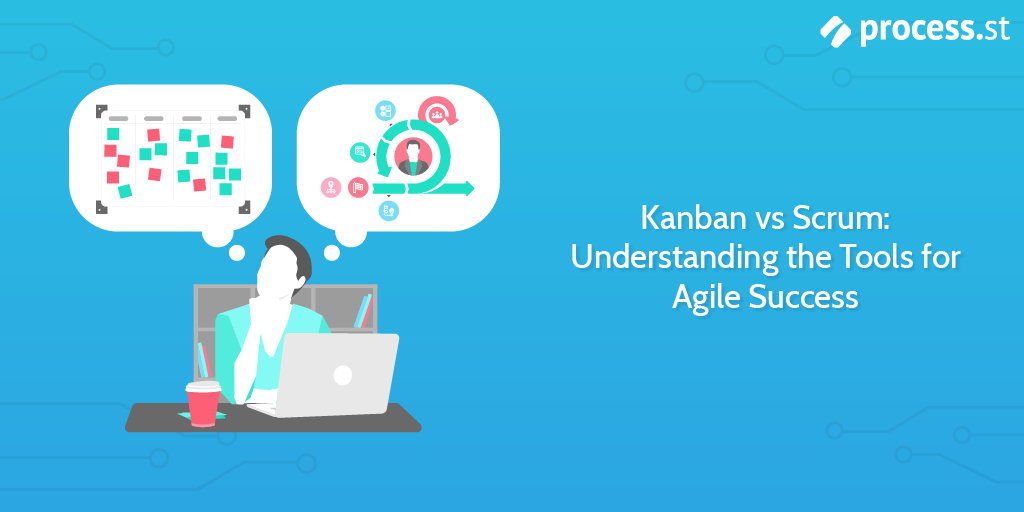
You’ll often hear the question: “Which is better? Kanban or Scrum?” or variations of this eternal deathmatch between two of the most well-established agile methodologies.
People are wasting energy fighting over which methodology trumps another. If you’re an agile organization, you should be placing principle above practice.
It makes a lot of sense to ask questions like “why might I want to use Kanban over Scrum?”, or even “Kanban and Scrum” as opposed to “Kanban vs Scrum”. There are a lot of differences between the two, but fundamentally, they are both agile methodologies, and the principle behind why you might want to use both can be in alignment.
You may even find they can work well together, as part of a unified strategy referred to as Scrumban. You need to consider what approach will work best for your team.
My aim with this article is to approach the question of “Kanban vs Scrum” by clearly presenting both approaches in terms of when, how, and why you might choose to use either of them.
I’ll also talk about the capacity for overlapping Kanban and Scrum approaches, and how some additional tools like Process Street can factor into that equation.
Here’s a breakdown of how we’ll approach comparing “Kanban vs Scrum”:
How do you stand out against overwhelming competition? You need an edge; a value proposition isn’t enough on its own.
You need to make sure you’re out-competing the competition by keeping costs down and understanding the value you’re delivering to your customer. But how do you continuously improve your value offering while keeping costs down?
Enter the value chain.
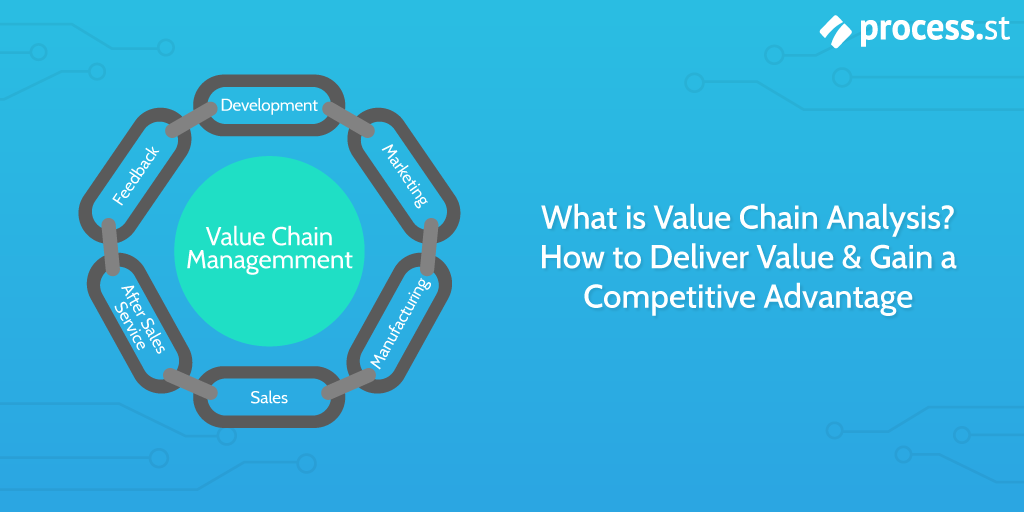
A value chain is a model of looking at all of your business processes and figuring out how to gain a competitive advantage by focusing on developing maximum value in your product or service, while keeping your profit margins in the green at the same time.
Originally proposed by Harvard’s Michael Porter in his 1998 book Competitive Advantage, there’s a lot of ground to cover. Where do you start? What’s the process? What kind of tools exist to make the value chain analysis easier?
Well, if you’re looking for a clear, concise introduction to Michael Porter’s Value Chain model, you’ve come to the right place. Read on for a breakdown of:
By the end of this article, you should have a firm grasp on the value chain model, with a better idea of how to apply it to your own business. We’ll also investigate how to integrate BPM software like Process Street into the value chain. Continue Reading
How do you know whether you’re going to be successful or not with a new business or product?
Well, you’ll probably look to pour your heart and soul into it. You’ll work hard to make it the best product or service you can. You’ll endeavor to make each and every customer happy.
And well done to you for that.
But you’re not the only one who impacts on whether your efforts are successful.
It’s no secret that one of the hardest parts of business is the competitive nature of the market.
What your competition looks like, how it’s constructed, and what opportunities their weaknesses provide you, are crucial factors which can determine your success.
This is where you’ll need to do some kind of competitive position analysis.
In this Process Street article, we’ll look at a framework which is designed to help you understand your competition called Porter’s Five Forces. We’ll cover:
Approvals are everywhere. If you’ve worked on any project involving any kind of deliverables, chances are you’re all-too-familiar with the approval process (or rejection process, depending).
Documents, prototypes, reports, mock-ups, wireframes, storyboards, and even more internally-facing elements like simple holiday leave requests. All of these represent different kinds of approval process, and approvals are an integral workflow element.
Approvals can also represent a major bottleneck.
Consider how you are currently approving work in your business. Perhaps you have a vague process involving emails, and if you’re particularly attentive you might be tracking it in a spreadsheet.
These methods are slow and prone to delays. You have no way of tracking anything reliably, you are more likely to miss approval windows, and information has to be sent manually between individuals.
What’s more, it’s quite difficult to improve this process without the proper system in place. You need to make sure you’ve got the right tools to optimize your approval process.
Process Street‘s approvals feature is the solution to this problem.
We created the approvals feature to make the process of approving work as fast and easy as possible.
With approvals, you can:
Get notified as soon as work is ready for approval
Approve (or reject) work with zero friction using a clear, streamlined interface
Approve on-the-go, from your phone’s email inbox
Synergize with many other Process Street features to optimize process efficiency
Save time and stay on top of your workflow
In this post, I have a trove of templates to showcase the approvals feature. All of the templates in this article are custom-built to make your life easier.
Only 23% of surveyed CEOs believe that they have comprehensive information about the risks of their business.
Can you confidently state that you belong in that 23%?
Even if you are not a CEO, as an employee, are you sure you know all the risks within your workplace?
If not, then keep reading.
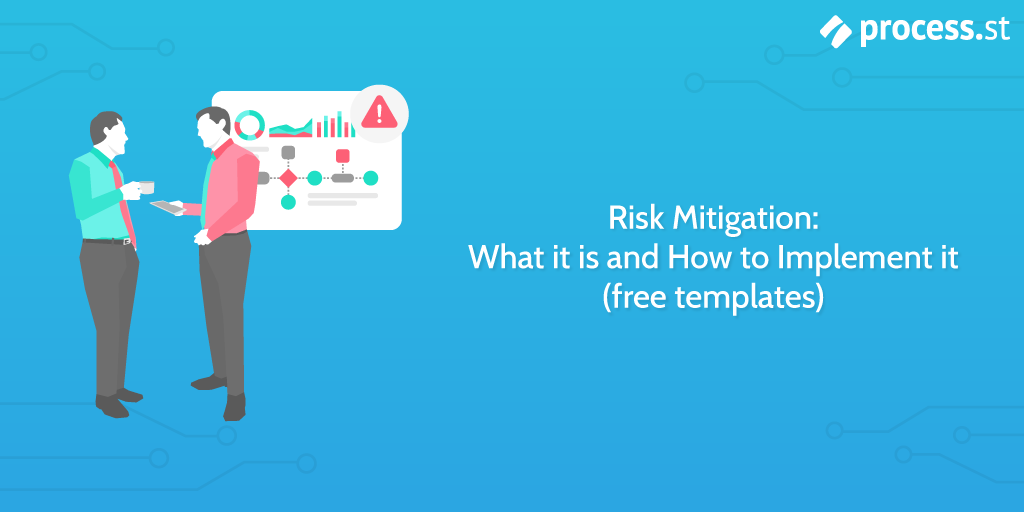
In this article, you will learn about risk and how to manage it, specifically via risk mitigation. You are also provided with a thorough list of Process Street resources and templates. These are designed for you to gain a good understanding of business risk, risk management and risk mitigation.








 How do you know whether you’re going to be successful or not with a new business or product?